
Cilantro is one of the most polarizing foods out there. Some people taste soap, others taste fresh herbs, and it’s all encoded in your DNA, right? A simple gene that decides whether you love it or hate it.
But what if I told you it’s more complicated than that? That you might actually be able to train yourself to like cilantro — or that your hatred of specific food could fade over time?
And what if the cilantro story is just the beginning of understanding why we eat what we eat?
Food is often reduced to nutrients
If you scroll through nutrition advice online, you’d think food is simple.
Count your macros, eat enough protein and avoid sugar. Food becomes a spreadsheet of nutrients and calories as if our bodies were machines that just need the right fuel mix.
But if eating were purely biological, wouldn’t we all crave the same foods? Wouldn’t there be one optimal diet that works for everyone, everywhere?
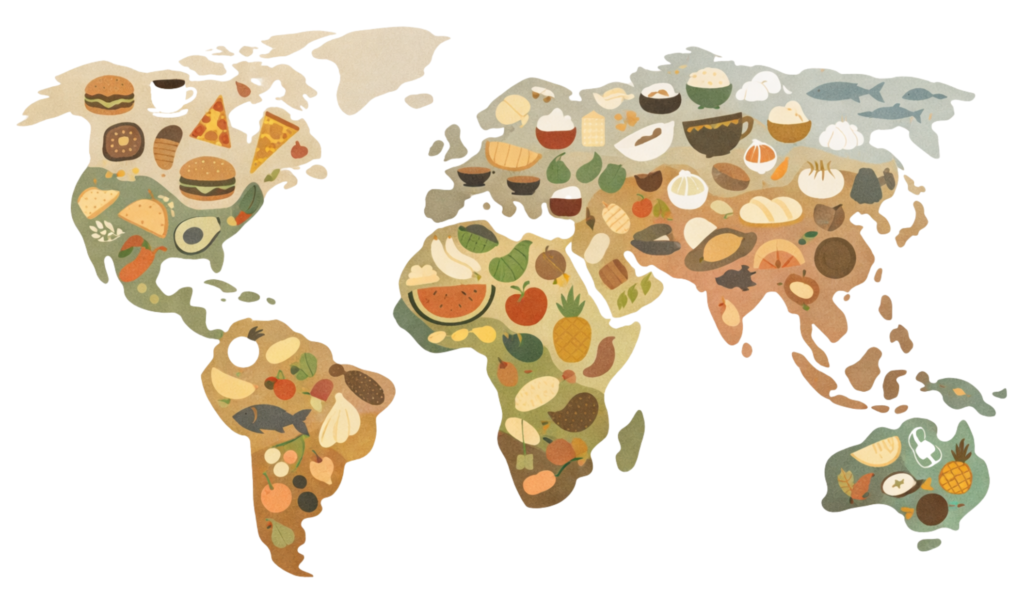
Walk into any market around the world and you’ll see completely different foods considered “normal” or “delicious.” What’s comfort food in one culture is unfamiliar in another. And this isn’t random. I want to show you why viewing food as just nutrients misses the whole picture. Because once you understand how taste develops, how preferences are learned and how culture shapes what ends up on your plate, you’ll see why there’s no single “right” way to eat (and why that’s actually a good thing).
The biological basis of taste
Let’s start with what we’re born with.
You come into this world with taste receptors already wired into your tongue. Sweet, salty, sour, bitter, umami — these five basic tastes are your biological starting point. They evolved as survival tools: sweet signals energy, bitter warns of potential toxins (1). But here’s where it gets interesting: not everyone experiences these tastes the same way.
Take bitterness. There’s a specific taste receptor called TAS2R38 that detects bitter compounds. Depending on your genetic variation, you might be a “supertaster” who finds broccoli, coffee or dark chocolate intensely bitter or you might barely notice any bitterness at all (2). This isn’t about being picky. It’s literally written in your DNA.
When someone says “I don’t like coffee,” they might actually be tasting something fundamentally different than you are. Their experience of bitterness could be twice as intense as yours. But, and this is crucial, biology doesn’t tell the whole story. If genetics determined everything, people with the same bitter taste genes would all eat the same foods, but they don’t. Which means something else must be happening.
Biology explains how we taste. It doesn’t explain what we choose to eat.
Learning, exposure and taste adaptation
Your taste preferences aren’t fixed at birth. They’re shaped by experience, starting surprisingly early.
Even before birth, flavor compounds from your mother’s diet passed into the amniotic fluid and later into breast milk. Research shows that early exposure to certain flavors increases acceptance of those foods later in life (3).
This continues throughout childhood and beyond. Remember the first time you tried olives, coffee or blue cheese? Probably didn’t love it, right? But if you kept trying it, maybe because your family ate it regularly or you lived somewhere where it was common, something shifted. What was once weird or unpleasant became familiar. Eventually, it might have become something you actually craved.
This is exposure learning in action. The more often you try a food in safe, positive contexts, the more your brain categorizes it as “normal” and acceptable (4). This is why foods that taste strange at first can become favorites over time. I experienced this myself when I moved cities and started exploring different food cultures. Foods I initially found too intense or unfamiliar became dishes I actively sought out. My taste receptors didn’t change, but my brain did.
What’s remarkable is that this learning never stops. You can develop new preferences at any age. This is the bridge between biology and culture. Your genes give you the hardware, learning writes the software. And culture? That’s the operating system everything runs on.
Culture as a key determinant of food choices
Now we get to the part that really explains why people eat so differently around the world. If I gave you a plate of insects, would you eat it? What about Chinese century eggs or raw fish? Your immediate reaction isn’t just personal, it’s cultural. Where you grew up and what your community considers “food” shapes these reactions more than biology.
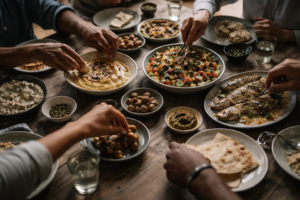
Large-scale studies show clear patterns: dietary habits cluster along cultural and historical lines, not biological ones. These patterns persist even when people migrate (5). A Japanese person living in Germany might still prefer Japanese flavors. A Mexican family in the United States often maintains traditional food practices across generations. This happens because food is never just food. It’s a huge part of peoples identity and belonging.
Research shows that cultural values, like individualism versus collectivism, actually influence how people make food choices (6). These are social decisions, not just biological ones. One of my favorite examples here are holiday meals. The specific dishes matter not because they’re nutritionally superior, but because they carry meaning. They connect you to your past, your people, your sense of who you are. This is why two people with identical genetics and nutritional needs will still eat completely different foods because they grew up in different cultural contexts.
There is no single “right” diet
This is where things get uncomfortable for the diet industry.
You’ve probably encountered nutrition advice that presents one diet as the answer (e.g. keto, paleo, mediterranean or plant-based). Each one claims to be the optimal way humans “should” eat. But here’s what the actual science tells us: there is no single ideal diet that works equally well for everyone. Because people are different — biologically, culturally and practically.
Genetic variation affects how your body processes nutrients. Your gut microbiome, metabolism and hunger signals all show individual variation (7). Then add culture and context: What foods are available where you live? What can you afford? What does your family eat? What are your religious practices?
Dietary guidelines try to account for this complexity, but they have real limitations. They’re based on population-level data, cultural norms, and political considerations as much as pure science (8). They describe general patterns, not individual truths. This doesn’t mean nutrition science is useless. It means it’s contextual. The evidence shows relationships between diet patterns and health outcomes, but it cannot prescribe one universal “correct” diet.
For you, this should actually be liberating. You don’t have to force yourself into someone else’s dietary ideology. Understanding how biology, learning, and culture interact gives you permission to eat in a way that makes sense for your body, your life, and your values.
Why food advice often feels confusing
Let’s be honest: nutrition advice is a mess. One week fat is bad, next week carbs are the enemy. Sugar is toxic or fine in moderation. Eat breakfast or try intermittent fasting. It’s exhausting.
This happens because most food advice ignores context.
When recommendations are stripped of nuance and presented as universal rules, they stop making sense. Not only biology, but also culture and individual needs vary among people, but “eat foods that work for your unique context” doesn’t make a catchy headline (9).
There’s another problem. Food advice often reflects cultural assumptions disguised as science. What’s considered “healthy eating” in one country might emphasize completely different foods than in another. Not because the biology is different, but because the cultural framework is different (10).
When you recognize this complexity, food becomes less about guilt or perfection and more about curiosity and learning what actually works for you. That’s what I want to bring to this space. Not another set of rules. Not another “perfect” diet. Just a clearer understanding of how food actually works — scientifically, culturally and personally. Because food is fascinating. And you deserve to understand it, not just follow someone else’s prescription.
What this means for you
So where does this leave you, practically?
Stop expecting one “right” answer. If a diet plan claims to be universally optimal, be skeptical. Your biology, your lifestyle and your culture matter.
Pay attention to your own responses. What foods make you feel good? What foods connect you to people or memories you value? These aren’t just “emotional” considerations, they’re legitimate parts of how food works in your life.
And remember: understanding why people eat differently doesn’t mean “anything goes”. Nutrition science has real insights to offer. But those insights work best when applied with flexibility, context and respect for the fact that food is never just nutrients.
It’s a combination of culture, biology, experience and meaning.
Food is more than we often give it credit for.
— Lena
References
(1) Ventura AK, Worobey J. Early influences on the development of food preferences. Current Biology. 2013;23(9):R401–R408.
(2) Lipchock SV, Mennella JA, Spielmann AI, Reed DR. Human bitter perception correlates with bitter receptor messenger RNA expression in taste cells. Am J Clin Nutr. 2013 Oct;98(4):1136-43.
(3) Nehring I, Kostka T, von Kries R, Rehfuess EA. Impacts of in utero and early infant taste exposures on later taste preferences and eating behavior. Annals of Nutrition & Metabolism. 2017;70(3):217–221.
(4) Beauchamp GK, Mennella JA. Early flavor learning and its impact on later feeding behavior. J Pediatr Gastroenterol Nutr. 2009 Mar;48 Suppl 1:S25-30.
(5) Aneli S, Mezzavilla M, Bortolini E, Pirastu N, Girotto G, Spedicati B, Berchialla P, Gasparini P, Pagani L. Impact of cultural and genetic structure on food choices along the Silk Road. Proc Natl Acad Sci U S A. 2022 Nov 22;119(47):e2209311119.
(6) Prescott J, Sweeney A, Cattaneo C. Culture, identity and food choice: moving beyond biological determinants. Appetite. 2021;164:105279.
(7) Dean E, Xu J, Jones AY, Vongsirinavarat M, Lomi C, Kumar P, Ngeh E, Storz MA. An unbiased, sustainable, evidence-informed Universal Food Guide: a timely template for national food guides. Nutr J. 2024 Oct 18;23(1):126
(8) Mozaffarian D, Rosenberg I, Uauy R. History of modern nutrition science-implications for current research, dietary guidelines, and food policy. BMJ. 2018 Jun 13;361:k2392.
(9) Hassel CA. Reconsidering nutrition science: critical reflection with a cultural lens. Nutr J. 2014 May 2;13:42.
(10) Landry MJ, Ledoux TA, Collins SC, Linsenmeyer W, Gonzalez AL, Wall-Bassett ED, Wijayatunga NN, Rozga M. Communicating Nutrition and Dietetics Research: A Crucial Step to Advancing Evidence-Based Practice. J Acad Nutr Diet. 2024 Dec;124(12):1668-1678.