
Once upon a time, someone decided female biology was too complicated for clinical trials.
Until 1993, medical research happened almost exclusively in men, with the assumption that findings would translate directly to female bodies. They didn’t.
Women started noticing they react stronger to vaccines and are also more likely to develop autoimmune diseases compared to their male partners. When women brought these observations to doctors, they were told they are overreacting and too sensitive.
But here is what I wish someone had told me years ago: we’re not being dramatic and we’re not more sensitive just because we’re female. Nobody ever taught us that the female immune system works fundamentally differently.
When I finally understood the scope of these differences, I had this moment of clarity mixed with frustration: we’ve been treating female immune systems as if they’re just smaller, more hormonal versions of male ones. But the biology is so much more complex and interesting than that. And almost nobody is explaining this to the people who actually live in these bodies.
How female immune systems work
Let me share what the research actually shows, because this should be basic knowledge but somehow isn’t.
Bodies with ovaries typically mount more vigorous immune responses than bodies with testes. Higher antibody production, stronger immune cell responses and more inflammatory activation in many situations (1-4). This pattern shows up in several vaccine studies, where women tend to produce higher antibody levels than men for flu shots, hepatitis B and other vaccines (3). When researchers measure inflammation during infections, female immune systems tend to light up more intensely.
What does this mean in practice? You might clear some infections faster than men. But you’ll also likely experience more intense vaccine side effects, stronger inflammatory reactions and higher risk for autoimmune conditions.
But it’s important to notice that your body isn’t overreacting. It’s responding exactly as it evolved to respond.
So where do these differences come from? Three main things contribute and they all work together.
Estrogen and progesterone control immune response
Estrogen, progesterone and testosterone — you probably learned about these in relation to periods, pregnancy and maybe menopause. But these hormones also have receptors on your immune cells. They’re literally telling your B cells, T cells and inflammatory cells how to behave.
Estrogen tends to turn things up. It can enhance B cell activation (the cells that make antibodies), boost antibody production and generally can make your immune responses more vigorous (1, 4, 5). This is why women often have higher baseline antibody levels and respond so strongly to vaccines.
When I learned this during my PhD, it suddenly made sense why I’d feel my immune system ramping up at certain points in my cycle. This was not at all random.
Progesterone does the opposite, as it tends to turns things down. It likely creates a more tolerant, less inflammatory environment (4, 5). This becomes crucial during pregnancy, when your body needs to not attack a fetus that’s technically half-foreign DNA. But even outside pregnancy, progesterone shifts your immune tone every single month during the luteal phase of your cycle.
Testosterone (yes, you have some too) generally dampens immune responses. This is part of why men have lower rates of autoimmune disease (1, 4). It’s like a brake on the system.
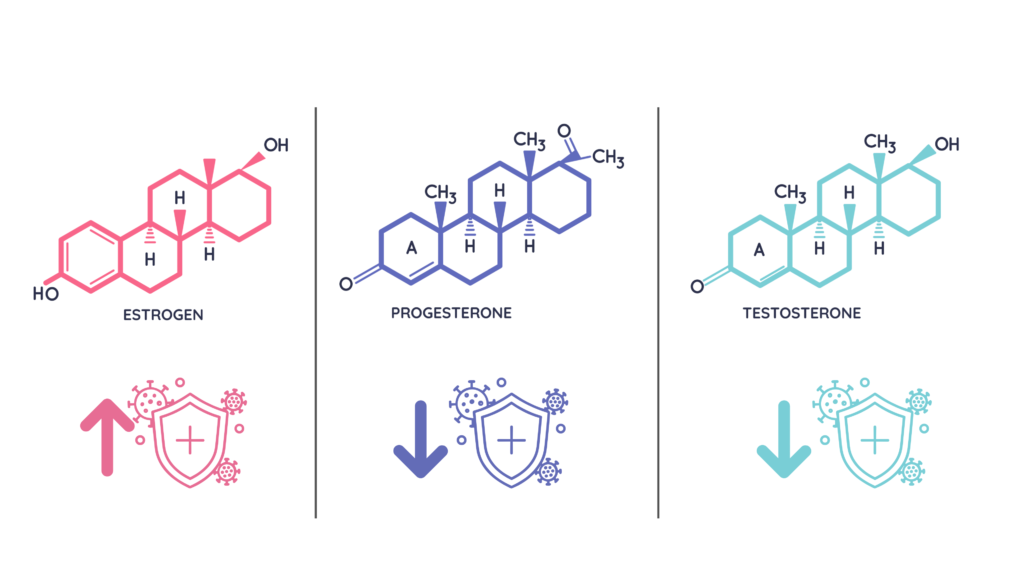
immune responses, while progesterone and testosterone are rather dampening them.
These aren’t small effects. When researchers actually measure immune markers across the menstrual cycle, the differences measurable. But who’s tracking that? Certainly not the doctors who keep telling us our symptoms are “just hormones” as if that’s not a legitimate biological mechanism.
Having two X chromosomes changes the game
Beyond hormones, there’s genetics.
A lot of immune-related genes live on the X chromosome. If you’re XX, you have two copies. If you’re XY, you only have one.
Normally, one X chromosome gets “turned off” in females (XX) to balance things out. But about 15% of genes escape this shutoff (6, 7). Which means throughout your entire life, you’re expressing higher levels of certain immune genes than men.
This affects how your B cells develop, how prone you are to making autoantibodies, how reactive your immune system is overall.
Even before puberty, before sex hormones kick in strongly, you can already see immune differences between male and female children. Your chromosomes set the stage.
Puberty, pregnancy, menopause: Your immunity at every stage
Here’s what makes this even more complicated: the female immune system doesn’t stay static.
At puberty, when sex hormones surge, immune differences become pronounced. A lot of autoimmune diseases first show up in adolescence or early adulthood (3, 8). Not a coincidence.
During your reproductive years, your immunity shifts every month with your cycle. Estrogen and progesterone rise and fall, and your immune defenses rise and fall with them. Some women notice they get cold sores at the same point every cycle. Or urinary tract infection. Or their chronic condition flares. That’s real and rooted in biology.
Pregnancy is the most extreme version of this, the female immune system completely remodels itself to tolerate a fetus. Many autoimmune diseases mysteriously improve during pregnancy, then flare postpartum (3, 8). Doctors have known this for decades but still don’t fully explain it to patients.
Menopause brings yet another shift. Estrogen and progesterone drop, and your immune landscape changes again. Some conditions can worsen, others stabilize.
Your immune system is constantly responding to your hormonal environment.
And almost nobody tells you this.
Why 80% of autoimmune patients are female
When I first understood these patterns, I had this moment of: wait, why didn’t anyone explain this before?
Because here’s what happens when your immune system runs that high: approximately 80% of autoimmune disease patients are women (3, 6, 8). The same immune system that produces protective antibodies against infections can also produce antibodies that attack your joints, your skin, your thyroid or your nervous system.
Think of it like having a very vigilant security system that occasionally mistakes residents for invaders. The system is just running at such high sensitivity that it sometimes misidentifies targets. This is an evolutionary trade-off that researchers are finally starting to map out.
The working hypothesis is that robust maternal immune responses evolved to protect offspring. During pregnancy, your antibodies cross the placenta and give the fetus temporary immunity. After birth, antibodies in breast milk continue protecting the infant (6). Your highly reactive immune system becomes your baby’s immune system until theirs matures.
The consequence is that this same high-reactivity system becomes more prone to attacking self, particularly in modern environments where we encounter fewer actual infections than our ancestors but maintain the same immune potential.
And here’s the part that really gets to me: when women show up to doctors with symptoms that could signal early autoimmune disease, how often are they told it’s just stress, just anxiety or just hormones? As if hormones aren’t legitimate biological mechanisms driving real physiological changes.
Why this matters for you
If you’re reading this and thinking “wait, nobody ever explained any of this to me”, you’re absolutely not alone.
I have a PhD in immunology, I studied this for years. And even I didn’t fully grasp how profoundly sex and hormones shape immunity until I started specifically looking for it in the research literature. The information exists, it’s well-documented in scientific papers, but it somehow doesn’t make it into standard biology education at any level, from high school through medical school.
So what does this mean practically?
When doctors run standard lab tests and say “everything looks normal”, those reference ranges were often established primarily in male bodies. Normal for you might look genuinely different, and that’s not a problem… it’s biology.
If you experience cyclical symptoms (joint pain before your period, energy crashes at predictable points in your cycle, cold sores that appear like clockwork) these probably aren’t random. They could be your immune system responding to hormonal shifts.
And if you develop an autoimmune condition, you’re not uniquely broken or unlucky. You’re part of a much larger biological pattern that science is only beginning to properly acknowledge and explain to the people it affects most.
Next in this series:
Female immune system across your cycle
Over the next weeks, I’m going to walk through how these patterns actually play out in your body.
Next, we’ll look at your menstrual cycle and immunity. How female immune defenses shift from follicular to luteal phase, why some symptoms follow monthly patterns and what this means for things like vaccine timing and infection susceptibility.
I’m writing this because I wish someone had explained it to me. Female biology isn’t a complication or a deviation from some neutral standard. It’s how half the population’s bodies work and we deserve to understand it.
I’d love for every woman to read this, but let’s start with your circle. Share it with someone who’s been dismissed by doctors or told their symptoms were ‘just’ caused by hormones.
Take care!
— Lena

References
(1) Sciarra et al. – Gender-Specific Impact of Sex Hormones on the Immune System, 2023, Int J Mol Sci, https://pmc.ncbi.nlm.nih.gov/articles/PMC10094624/
(2) Ortona et al. – Sex Hormones and Gender Differences in Immune Responses, 2019, Front Immunol, https://pmc.ncbi.nlm.nih.gov/articles/PMC6530401/
(3) Giefing-Kroell et al. – Sex Hormones in Acquired Immunity and Autoimmune Disease, 2018, Front Immunol, https://pmc.ncbi.nlm.nih.gov/articles/PMC6180207/
(4) Klein & Flanagan – Sex differences in immune responses, 2016, Nat Rev Immunol, https://pubmed.ncbi.nlm.nih.gov/27528521/
(5) Roved et al. – Sex differences in immune responses: Hormonal effects, natural selection, and evolutionary adaptation, 2017, Biomed Res Int, https://pubmed.ncbi.nlm.nih.gov/27956226/
(6) Ngo et al. – Why women have more autoimmune diseases than men: An evolutionary perspective, 2020, Evol Appl, https://pmc.ncbi.nlm.nih.gov/articles/PMC7980266/
(7) Fairweather et al. – Mechanisms underlying sex differences in autoimmunity, 2024, J Clin Invest, https://www.jci.org/articles/view/180076
(8) Nussinovitch & Shoenfeld – Autoimmune Disease in Women: Endocrine Transition and Risk Across the Lifespan, 2019, Clin Immunol Rheumatol, https://pubmed.ncbi.nlm.nih.gov/30255339/